Barthes’ Mythologies and Ideological Incoherence in Matisse’s Blue Nude
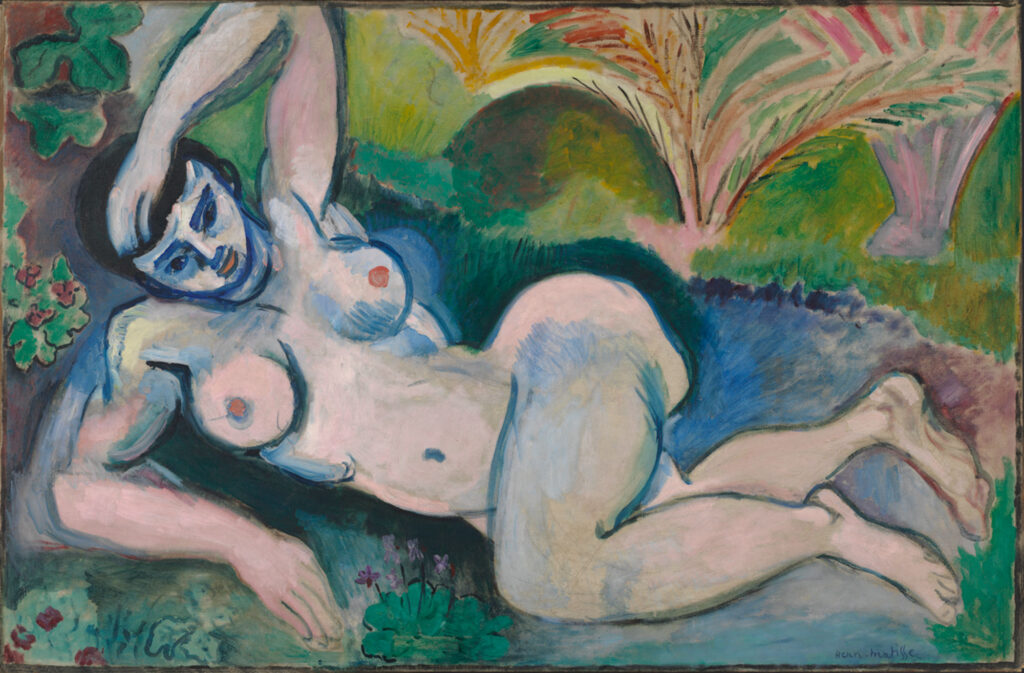
Henri Matisse’s Blue Nude (Souvenir of Biskra) (Fig. 1), done in 1907, is a physically imposing painting and is full of contradiction. It is large, nearly life-sized. Its old, golden-brown frame signifies antiquity, as does its subject, a classically posed female nude.1 As such, Blue Nude exists in a Western lineage stretching back to Greece and Rome. As a supposed portrait of a “primitive” colonial subject, moreover, it gestures towards an idealized human nature preceding civilization itself. And yet, Blue Nude’s technical heterogeneity and absolute rejection of naturalistic color mark it quite clearly as a product of a new and reckless avant-garde—of a modernism which, in 1907, worked to transcend the project of art as representation. Blue Nude foregrounds its paintedness, and the forms built up by that paint defy conventional relationships with perspective, with color, and most importantly, paradoxically, with Western tradition itself.
The painting sits heavily in the Baltimore Museum of Art; for even in all the broken rules of color and form that mark it as a work of radical experimentation, it possesses, still, the gravitas of a Michelangelo sculpture. The figure is solid: in the painted lines of her physique; the bulges and ripples of her flesh; in her presence and pose. We see someone in all her fullness, spilling over sideways. Her body may be asymmetrical, but it does not matter: she is not moving, she will never stand up. She is sexual, posed alluringly, and yet she lies at arm’s length. Her face is unreadable. She exists in her landscape in the fullest sense of the word in. She seems to belong to a time that is not ours, and she does not meet our gaze.
People have walked away from her confused, and angry. In 1913, Chicago art students burnt an effigy of the painting upon its exhibition in their city, charging its creator with “murder” and “rapine” (Wright 190). At first, such anger—especially from artists—seems strangely placed. What in the painting merits it? The European painterly tradition of posing so-called “foreign” subjects in classical Western fashion had deep roots.2 In this sense—with allowances for modernist stylistic flourish—Blue Nude seems no different from Gauguin’s celebrated Primitivist painting, which, as we will see, flattened and minimized the “other” by depicting it along Western lines.
But this understanding is incomplete. Blue Nude is not an essentially Orientalist, nor a straightforwardly colonial, painting: it found itself, in fact, at odds with a French classicism that accepted Gauguin as one of its own. Neither, though, is it essentially revolutionary, as we will soon see. It is a work of imagination from a singular avant-garde whose vision straddled those two ways of seeing, and whose virtuosic formal experimentation, perhaps by accident, produced a profound ideological incoherence. It is this incoherence—a refusal to play by any single set of rules, borne of Matisse’s free-spirited apoliticism—which caused such critical confusion and anger.
Roland Barthes’ 1972 book Mythologies, a staple of the field of semiotics, defines a specific theoretical sense of the word “myth” that will help us to unravel Blue Nude’s strange uncertainty. Semiotics is the study of signs, containing at its base the idea that objects can constitute a kind of speech—as a propaganda poster, for example, communicates a particular point of view. Barthes works from the basis that a sign is the combination of a signifier and a signified: a vessel and a message.3 For example, a heart is the signifier; love is the signified. Barthes defines myth as a second-order semiotic relationship between a language-object (in our case, a painting) and what he calls its concept—a motivation, both historical and ideological, that animates and ultimately defines it in the viewer’s eye (109–18). A language-object is itself already a sign; as lines of paint laid out in a certain way can represent, or signify, a human figure. In myth, this surface-level meaning, in the right circumstances, yields to what Barthes calls form: emptied of individual history in order to speak of ideas beyond itself. (The specific identity of a soldier on a military poster, for example, gives way to larger ideas about the cause that soldier represents.) Crucially, for Barthes, the meaning of this sign-within-a-sign is not wiped away entirely; but it submits to the concept, letting its object—the painted figure, the soldier—become a vehicle for ideology.4
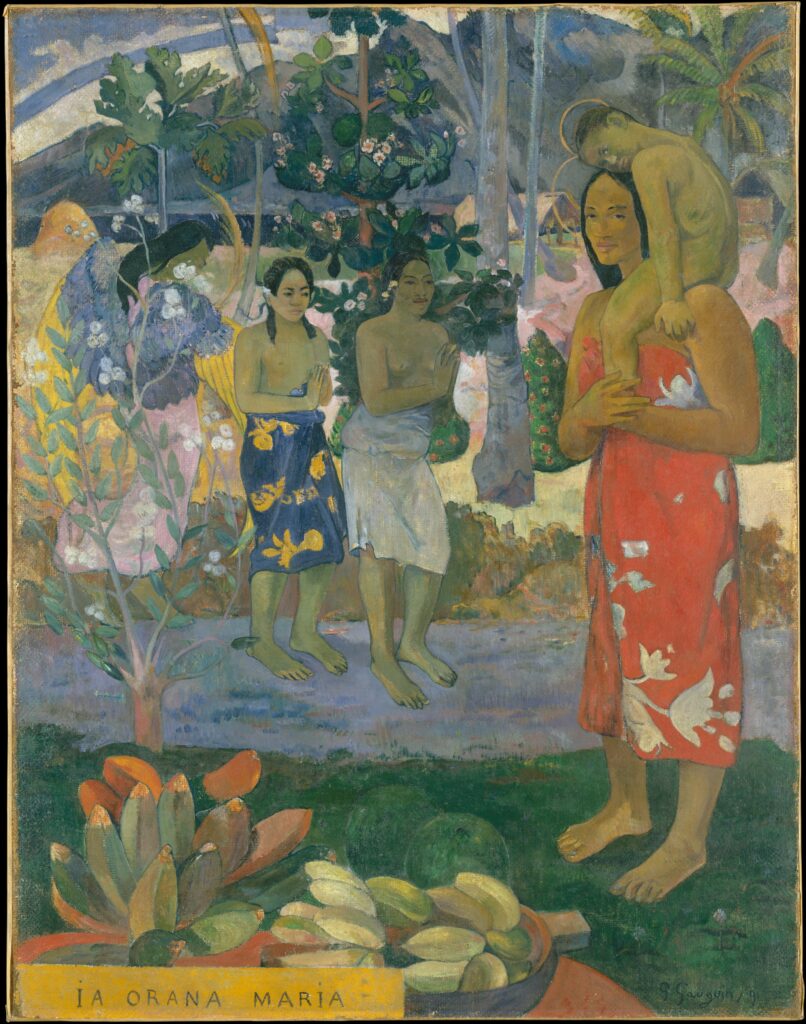
Take Gauguin’s Ia Orana Maria (Hail Mary) (Fig. 2), from the artist’s trip to Tahiti, in which a Tahitian woman and her son (right) are depicted as Mary and baby Jesus. Other locals look on, their hands in prayer. The Primitivist project here, as outlined above, is to render the foreign entirely legible by casting it as European. Its meaning is a set of Tahitian people in Tahiti, two of whom are set apart by the halos on their heads. But Gauguin’s motivating concept, Primitivism, shines through, and in the viewer’s eye meaning becomes form. Any specific life these women might have had is no longer the concern. They play Christian parts, therefore representing European ideals. A picture of life lived in another country, one might think, could evoke a sense of the breadth of human experience, or of what life might be like under different cultural circumstances. Ia Orana Maria is no such picture. It treats apparent foreignness as no more than a badge; as myth, it has stripped away the very history one might expect it to explore. Gauguin both literally and aesthetically fetishized the people of Tahiti, rendering them here as afterimages of the West—vessels for Catholic iconography. As Barthes wrote about an Orientalist film: it “postulat[es] an Orient which is exotic in form, while being in reality profoundly similar to the Occident” (94). This makes things far easier for the Western viewer: with fewer differences to parse, “foreignness” can be treated as simply “exotic.” The Primitivist gaze requires no empathy, requiring a foreign subject that is maximally legible. To suit this purpose, Gauguin’s figures here are no more than polite props: forced into a Western mold, for the benefit of a Western viewer, so that this viewer may comfortably weigh the merits of their own society.
The “essential function” of myth, Barthes writes, is to “transform history into nature” (130, 128). History is, inevitably, political: the history of colonialism, of exploitation—power consolidated by the few at the expense of the many. Nature by contrast needs no justification. Speech originates, of course, in real, lived, political circumstance; but mythical speech works to conceal this fact. Says Barthes: “what causes mythical speech to be uttered is perfectly explicit, but it is immediately frozen into something natural; it is not read as a motive, but as a reason” (128). Spoken from a place of power, mythical speech reinforces bourgeois hegemony by obscuring its historical artifice. Gauguin’s painting, motivated by a Primitivist concept which implicitly reduced the subjects of colonialism into fetishized counterpoints to the West, worked to mythically naturalize the very colonial relationship that enabled it in the first place. In the late nineteenth century, Europe’s budding curiosity for the exotic fruits of exploration could find no better outlet: that which rendered the “other” familiar enough to be unthreatening, and that in so doing affirmed the imagined primacy of Western society. As the historical contingency of colonialism is obscured, myth replaces it with a soothing picture: in Barthes’ words a “harmonious display of essences” (142).
Blue Nude partially fits this mold—it is, after all, a Frenchman’s view of Algeria.5 Matisse paints his subject as if she belongs in nature; harmoniously at rest. She is given a statuesque, fundamentally solid aspect, but Matisse also syncretizes her with the landscape. She sits starkly on a void, a blue-black gradient, and yet picks up its colors. Her right arm, her left breast, and her right foot each find a double-image smeared in behind them. She never overlaps the scenery that sits beside her—and it is beside, not behind, for this picture has no real sense of perspective. The curve of her hip matches that of the fern above it; she belongs to this land, and it belongs to her. She is—to Matisse, and to Western viewers—a foreign woman posed primevally in her foreign landscape; certainly, in this respect, the piece recalls Gauguin. As Jack Flam writes in Matisse and Picasso:
It is as if the rootlike form of the woman, at once contained by and bursting from the confines of the earth, has caused the forms around her to burgeon into existence. The woman is symbolic of the primitive intensity and violence of the land Matisse sensed when he visited the Algerian oasis at Biskra the previous spring, and is a convincing metaphor for dynamic growth—a kind of modern African Venus. (35)
Stylistically, Flam writes, the work is “overtly primitivistic,” stemming from a “benevolent image of the French African colonies …where the Africans were supposed to embody a surviving instance of the noble savage” (Matisse and Picasso 41). Blue Nude betrays Matisse’s fascination with, as he wrote, “the new types of human being I was seeing” in Biskra; in other words, an aesthetic appreciation, built on novelty, that upon his return from Africa gave him “a furious urge to paint” (qtd. in Spurling 360). A likely inspiration, as has been pointed out by Wright and Spurling, were the belly-dancing women of the Ouled-Nails tribe in Biskra: the only unveiled women in Algeria, famous for their “muscular bodies,” who “made the town a sexual tourist trap” for the visiting men of France (Spurling 359).
The work is, absolutely, sexual. Matisse compositionally emphasizes his figure’s breasts and hip, the form of her muscle and flesh. Her arm raised alluringly above her head; she poses for the viewer. The women of Ouled-Nails, as well as the nude models in the pages of L’Humanité Féminine that Matisse often consulted, were presented as sexualized female subjects expressly for the male viewer. Among all the varying criticism that Blue Nude received, among the most memorable is an anecdote from Gertrude Stein—of a little boy who, upon seeing the painting, “cried out in rapture, oh là là, what a beautiful body of a woman” (qtd. in Flam, Matisse and Picasso 36).
Viewed as a sexualized and essentially foreign subject—considering especially Blue Nude’s musculature, its conceptual inspiration, and the figure’s close affinity with plants, which Matisse included to remind him of Biskra (Spurling 374)—the painting makes itself readable as myth. Our language-object here is the woman-in-nature, essentially an exotic woman, who presents herself yet along familiar (and still sexual) Western lines as a “modern African Venus.” Matisse heavily references the Western classical tradition. Indeed, the museum label for Reclining Nude I (Aurore), the sculpture of an identical motif that presaged Blue Nude, likens its physique to that of Michelangelo’s figures for the Medici tomb.6 Flam writes that Blue Nude borrowed from Ingres’ 1814 Grande Odalisque a certain “melodic profile” not present in the more progressive avant-garde of the late nineteenth century (“Matisse and Ingres” 22). Just as Gauguin relied on the aesthetic trappings of Christianity to make the exotic play easily to European eyes, Blue Nude’s foreign yet classical form is readable through a bourgeois-colonial lens. It depicts the essential, Oriental character, framed and posed in the terms of the West. We might call its concept primordiality, or a Primitivism akin to Gauguin’s. In this light, Blue Nude signifies the fundamental knowability and familiarity of the so-called Orient, together with a colonial-tourist sort of exoticism: a frame of mind in which a sexual encounter between a white man and nonwhite woman might be “acceptably” enjoyed. As, in 1907, France moved from Algeria to conquer Morocco, such racial-sexual hegemony was vital in preserving colonial power (Wright 175).
Yet, insofar as the purpose of myth is to soothe the structures of power by naturalizing their dominion, Blue Nude, quite spectacularly, failed to do so. It, instead, was met with an astonishing variety and intensity of criticism (recalling the charges of “murder” and “rapine”) that cast the work as, somehow, fundamentally violent. This stems from, as Alistair Wright persuasively argues, the work’s confusion of racial signs—a recombination that threatened, rather revolutionarily, to break down the very myth the work might be said to support.
This confusion starts with a visual quality of the painting that we have thus far ignored—the color of the woman’s skin. Her skin is only actually blue in shadow, and its prominent tone is pink: she therefore signified, at the level of the language-object, whiteness, or European-ness, according to the conventions of the time. A browner pigment would have safely conveyed the skin of a North African, as Wright notes of Dinet’s Flight of the Bathers. This is because categorical boundaries in skin tone between the East and West, though ultimately a fiction, were useful to mark the Oriental as an “other” (169–70). Wright argues that the variations in tint within the figure suggest an instability in the pigmentation of the body itself—which, given Orientalist beliefs in essential differences of East and West, proved deeply unsettling (170). To add another point of confusion for critics, at the 1907 Salon des Indépendents, the work was shown simply with the title Tableau No. III, missing the crucial subtitle, Souvenir of Biskra, that otherwise may have cleared up its racial confusion. Wright notes that, thanks to these ambiguities, and without any clear reason to assume otherwise, most Salon-goers understood Blue Nude (or, rather, the unnamed Tableau) as a picture of a European woman. Rather than an example of the foreign body bent toward a European ideal, she becomes a development of that ideal itself: to the European colonial gaze, she distorts the very center of civilization.
When bestowed on a woman apparently of the West, many of the work’s previously acceptable qualities—a sense of masculinity, the bulging of her body, a general transgression of Western feminine beauty ideals and of whiteness itself—become unacceptable. Much of Matisse’s oeuvre shared these qualities, and they became a common point for critical attack. Wright points out that by failing to imitate the “safe segregation” of Gauguin’s work, Matisse—in Blue Nude, as in Le Luxe (I) and (II) (both 1907), Red Madras (1910), and Dance (1910)—destabilized the assumptions of colonial ideology in distressing ways. He writes:
When the West penetrated North Africa [or Tahiti, as in Gauguin], all was well; such exocentric movement lay at the very heart of the imperial project. When the traffic…was reversed, it was far less welcome. Matisse’s canvases spoke not only to the way a set of distinctions between East and West previously held to be inviolable came to be questioned, but also to the dangerously endocentric traffic by which the East was felt increasingly to impinge upon the purity, both physical and cultural, of Western identity. (187)
That the critics Vauxcelles and Flament mobilized words such as “kanak,” “creole,” and “mulatto” to frame Matisse’s paintings as acts of racial invasion puts in particular relief the anxieties that his work stoked. Matisse’s decision not to title Blue Nude—to withhold giving it explicit racial context—did nothing to allay these anxieties. It would seem he either did not foresee them or did not care.
Or, perhaps, were those reactions his whole point? To the extent that Blue Nude can be understood as a response to neo-classicist critic Maurice Denis’ charge that Matisse take recourse in tradition—that he “accept without too many scruples much of the experience of the past” (Benjamin 94)—the work seems like an overtly political statement, an obliging swipe by the avant-garde at that which Denis and his neo-traditionalists held most dear. Flam calls Blue Nude an “anti-Salon painting” and “a violent reaction to academic nudes” (“Matisse and Ingres” 21). Spurling writes that it constituted part of Matisse’s “struggle to break free from the past” (372–73). Matisse’s use of specifically and recognizably classical subjects in his efforts, for Blue Nude as for Le Luxe (I) and (II), earned him ire from the political right, as well as from a general art-consuming populace that simply did not understand what he was doing or why he was doing it.
Matisse’s 1908 “Notes of a Painter,” ostensibly written to clear up confusion about the artist’s intentions, offers a passage that could be taken as support for this political reading:
What interests me most is neither still life nor landscape, but the human figure. It is that which best permits me to express my almost religious awe towards life. I do not insist upon all the details of the face, on setting them down one-by-one with anatomical exactitude. If I have an Italian model who at first appearance suggests nothing but a purely animal existence, I nevertheless discover his essential qualities, I penetrate amid the lines of the face those which suggest the deep gravity which persists in every human being. (38)
That deep gravity which persists in every human being. This could simply be read as platitude. But one could also take the artist at his word—understanding that by “every human being,” Matisse did mean “every.” Taking this statement together with the work’s racial indeterminacy, it is tempting to call Blue Nude a piece of fundamentally revolutionary, universalizing, anti-colonial art; to say that Blue Nude and its reception brought to the foreground those political and racial relationships intentionally taken for granted by the European powers that be. In doing so, it brought nature back to history.
But this narrative, just as that which took Blue Nude as wholly Primitivist, can only be taken so far. Take another passage from “Notes of a Painter,” one that more straightforwardly addresses the role Matisse wanted his art to play. “What I dream of,” he wrote, “is an art of balance, of purity and serenity, devoid of troubling or depressing subject matter, an art which could be for every mental worker, for the businessman as well as the man of letters, for example, a soothing, calming influence on the mind, something like a good armchair which provides relaxation from physical fatigue” (38). One would be hard-pressed to find a more bourgeois sentiment on the role of art; this is the language of the status quo, of a fundamental political ambivalence. “Notes of a Painter” is an essay primarily about aesthetic intuition, about the harmonies of composition and color, taken together as an artistic “expression” far more concerned with abstract feeling than any sort of conversation with political or material reality.
That singular sense of aesthetic intuition, Matisse’s revolutionary refiguring of color, pushed him continually to new places. His work was controversial precisely because it was not like anything anyone had ever seen before. Blue Nude and the sculpture that preceded it, Reclining Nude I (Aurore), were borne out of a phase of particularly radical experimentation—that did not need controversial allusion to be itself controversial. Spurling writes that “the more sensitive and highly trained the eye, the more it was repelled” by Matisse’s work of 1906–07. The young Walter Pach, coming into the world of modern art, took a full year, “jettisoning everything [he] had learned at art school as well as in the great museums of Europe,” before he could come to terms with Matisse (378).
Blue Nude and Reclining Nude I are works from memory; no one ever modeled for them. They serve, then, as particularly concentrated conduits for Matisse’s rather nebulous attitude towards ideas of foreignness—well summed up, I believe, by his remark about “the new types of human being” he saw in Biskra. He acknowledged, at least by linguistic implication, the fundamental unity of all people, yet still essentialized the foreign, the “new,” ever from the perspective of a colonial tourist. (After presumably receiving a lap-dance from one of the Ouled-Nails women, Matisse wrote in a letter back home, “What a joke!…You could see a hundred times better at the exhibition” [qtd. in Spurling 359].) Like Picasso, Matisse took genuine aesthetic inspiration from African art but saw this art as representing an essentially primitive counterpoint to the West—to be learned from, but only ever at a distance.
To borrow yet another definition from Barthes, Matisse cannot be a painter of the Left because he fails to identify himself with the oppressed (Barthes 148). He cannot be a true painter of revolution because, as Barthes writes, the avant-garde may stage aesthetic revolution, but the bourgeoisie is its public and it can only ever stray so far; in the end, “as for political contestation, there is none” (139). And yet, in Blue Nude, aesthetic revolution seems to touch the political, even just barely; for as Matisse experimented relentlessly with color and form, and as he made the rather conscious political decision to depict classical figures in avant-garde style, he evoked a deeper and rather destabilizing insecurity concerning the relationship between race and power—however apolitical Matisse may have been, and however much the residuals of Orientalist ideology corrupt him. As Wright writes, the work “hesitat[es] between subversion and affirmation, between a rendering incoherent of the ideological formations of orientalism and a reiteration of those same ideologies” (191). It lies halfway between hegemony and revolution, uncomfortably, not quite legible as part of either.
What Matisse was after was only ever accidentally or unconsciously ideological. His focus was above all else on finding new methods of expression: “By removing oneself from the literal representation of movement one attains greater beauty and grandeur” (Matisse 37). He lacked, above all else, a clear political motivation, a conscious concept, that let his work easily be read as myth. His work stuck out, therefore, quite rudely, incomprehensible to many.
In these conditions, though, myth paradoxically finds a final and comprehensive hold: a way of seeing abundant in the halls of the modern art museum that makes Blue Nude legible even in the face of such ideological disorder. Barthes writes that “what the form can give one to read is disorder itself: it can give a signification to the absurd, make the absurd itself a myth. . . Even the absence of motivation does not embarrass myth; for this absence will itself be sufficiently objectified to become legible” (126). Artistic style, along these lines, is “constantly threatened with formalization” (134). As soon as Matisse’s disordered and entirely unprecedented style—his anarchic color, the obviousness of his brushstroke, his disfigurement of the classical ideal—became familiar to the critical eye, it was formalized. Style itself became a sign.
The word Fauve (“wild beast” in French) was coined in 1905 by a Salon critic as an insult to Matisse’s pictorial vivacity (Spurling 332).7 Matisse’s notoriety was increasing along with his waywardness, which found him hated, scoffed at, laughed at, or adored—and the word Fauve, soon embraced by the public, gave those reactions a focusing and formalized label. To the viewer perplexed by Blue Nude’s incongruity, the names Fauve or Matisse can serve mythically to explain this incongruity, as simply a signifier of eccentricity. They serve, in place of ideology, as Barthes’ motivated form.
By first exhibiting Blue Nude under the title Tableau No. III, Matisse encouraged this way of seeing. The painting was Matisse’s third submission to the Salon des Indépendents, after two other boundary-breaking works: Luxe, calme, et volupté (1904) and Le bonheur de vivre (1905–06). Tableau No. III relates Blue Nude primarily to these other works, and Matisse’s own avant-garde reputation, instead of to its picture’s own content. Myth, otherwise evaded and half-met, finds in identifiable style a perfect signifier. Maurice Denis charged Matisse as a wayward artist bent on “reconstructing an entirely new art out of reason alone” (qtd in Benjamin 94). The uniqueness of Blue Nude, along with Matisse’s other paintings, makes it stick out perfectly, so tied to the identity of its creator, as a mythic object signifying that very effort of reconstruction. Its considerable political weight is subordinated when, approaching Blue Nude in a modern art museum, one sees it and thinks primarily, essentially: Oh, that’s a Matisse.
Footnotes
- Matisse specifically requested that his friend Henri Manguin find an “antique” frame for Blue Nude (Spurling 374). ↩︎
- See, for example, Ingres’ Grande Odalisque (1814). Painters of the Renaissance, prefiguring Orientalism, per se, depicted Biblical figures in a style modeled on Greco-Roman sculpture (e.g., Michaelangelo’s Sistine Chapel ceiling [1508–12], Raphael’s Transfiguration [1516–20], and Caravaggio’s Supper at Emmaus [1601]). ↩︎
- Following from Ferdinand de Saussure’s Course in General Linguistics (1916). ↩︎
- From this basis in semiology, Barthes argues that myth, as intuitively read by members of society, ultimately serves to naturalize the power of the bourgeois class. More recent scholarship—notably Chiara Bottici’s A Feminist Mythology (2022)—critiques this relationship, reconstructing myth to prioritize the voices of the women it represents. Taking up Barthes’ more descriptive project here, we may recognize and analyze how Blue Nude is both produced by, and serves to reinforce, patriarchal-colonial vision. ↩︎
- At the time of Matisse’s 1906 visit, Algeria had been subjected to French colonial control for more than seventy years. This would remain so until the end of a bloody war of independence in 1962 (Sutton). ↩︎
- Both the painting Blue Nude and the sculpture Reclining Nude I (Aurore) are on view at the Baltimore Museum of Art, placed next to one another. After dropping and ruining the sculpture, which he later re-finished, and “even before he set about picking up the clay pieces,” Matisse “recaptured the essence of his figure with heightened confidence on canvas” (Spurling 374). ↩︎
- Matisse relished the label: “Frankly, it was admirable. The name of Fauve could hardly have been better suited to our frame of mind” (qtd. in Spurling 332). The association of artistic freedom with “wildness” stretches back to Gauguin and further, and has an uneasy resonance when “wildness”—as in Gauguin—is associated with the nonwhite.
↩︎
Works Cited
- Barr, Alfred, Jr. Matisse, His Art and His Public. Museum of Modern Art, 1951.
- Barthes, Roland. Mythologies. Hill and Wang, 1972.
- Benjamin, Roger. Matisse’s “Notes of a Painter”: Criticism, Theory, and Context, 1891-1908. UMI Research Press, 1987.
- de Saussure, Ferdinand. Course in General Linguistics. 1916. Columbia University Press, 2011.
- Flam, Jack. “Matisse and Ingres.” Apollo, vol. 152, no. 464, Oct. 2000, pp. 20–25.
- ———. Matisse and Picasso: The Story of Their Rivalry and Friendship. Cambridge: Icon Edition, 2003.
- Herbert, James. Fauve Painting: The Making of Cultural Politics. Yale University Press, 1992.
- Matisse, Henri. “Notes of a Painter.” 1908. Matisse On Art, edited and translated by Jack Flam, E. P. Dutton, 1978, pp. 32–40.
- Nochlin, Linda. “The Imaginary Orient.” Art in America, vol. 71, no. 5, May 1983, pp. 118–31.
- Said, Edward. Orientalism. Random House, 1978.
- Spurling, Hilary. The Unknown Matisse: The Early Years, 1869-1908. Knopf, 1999.
- Sutton, Keith. “Algeria.” Encyclopedia Britannica, 12 Aug. 1998, https://www.britannica.com/place/Algeria/Colonial-rule.
- Wright, Alastair. Matisse and the Subject of Modernism. Princeton University Press, 2005.